
The Complete Guide To Hiring The Best Online Personal Trainer (2023 Buyers Guide)
Preparation Note:
This comprehensive guide is a deep dive into the world of online personal training, taking around 50 minutes to fully absorb. I assure you, by the end of this guide, you’ll have a complete understanding of online personal training – equipping you to evaluate whether it aligns with your fitness goals, anticipate what you can expect, and importantly, how to select the best coach to meet your specific objectives.
Feel free to brew yourself a cup of coffee before you start immersing yourself in this wealth of information. Alternatively, if reading isn’t your preferred way of learning or you simply wish to multitask, I’ve prepared an audio version of this guide. You can listen to me walk you through each detail by clicking here (link or embed audio version)
Why Online Personal Training Is So Popular in 2023:
Today in 2023, we’re so used to hiring professionals and making purchases online that the term online personal training or indeed hiring an online personal trainer is pretty much just taken as a variation on 1-2-1 in-personal fitness training. The recent pandemic contributed greatly to this as for the first time ever, gyms were closed and in-person training was prohibited for long periods of time across much of the globe
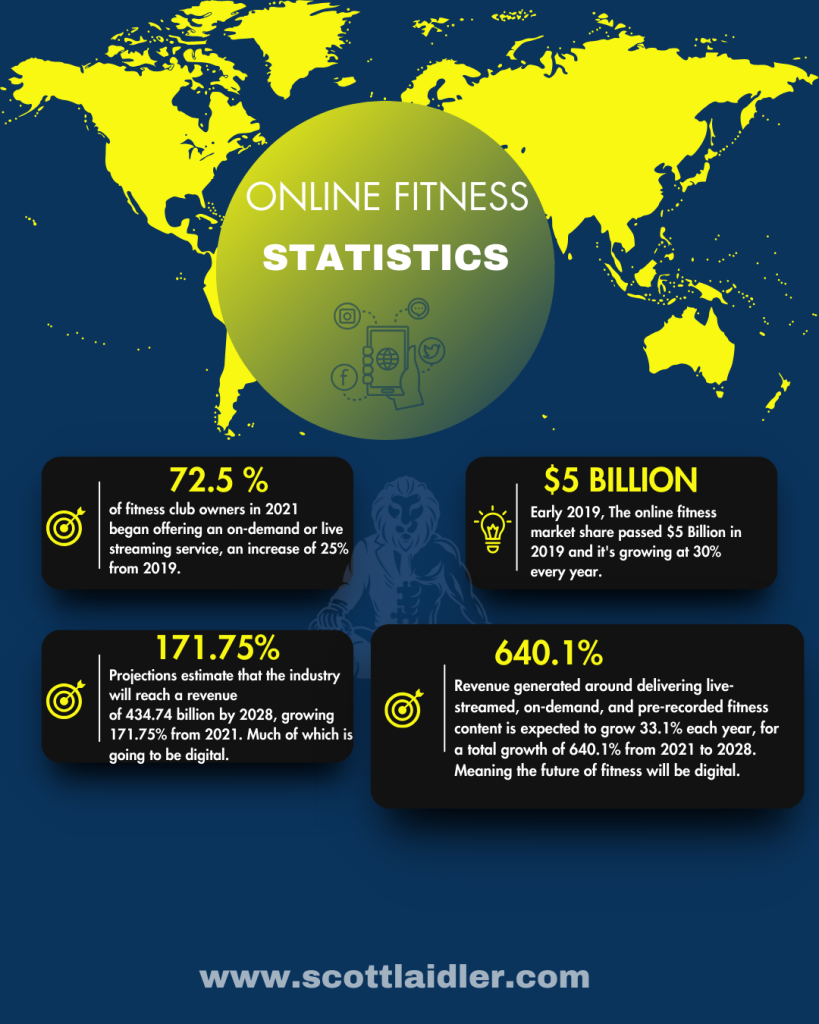
This resulted in online fitness businesses absorbing a huge influx of interest and new customers and forced gyms and fitness centers to adapt, in fact In 2021, 72% of fitness club owners began offering an on-demand or live streaming service, an increase of 25% from 2019.
However, the rise of online personal training cannot be attributed solely to the necessity the pandemic created, as even in early 2019, The online fitness market share passed $5 Billion in 2019 and it’s growing at 30% every year.
Indeed I have been offering my own online personal training service since 2015. So I think it’s more accurate to conclude that the pandemic helped expose people to the efficacy of online fitness coaching as a serious, in many cases superior alternative to in-person training. This is evident in the continued growth Online Fitness options have seen
With the global fitness industry projected to grow, in fact, Projections estimate that the industry will reach a revenue of 434.74 billion by 2028, growing 171.75% from 2021. Much of which is going to be digital.
In fact, the fastest-growing segment in the entire fitness industry is indeed online/digital fitness, which incorporates various forms of online personal training and online workout programs.
Revenue generated around delivering live-streamed, on-demand, and pre-recorded fitness content is expected to grow 33.1% each year, for a total growth of 640.1% from 2021 to 2028. Meaning the future of fitness will be digital.
There are many options when it comes to digital fitness, so I have created a buyer’s guide to the service I consider the Rolls Royce of Digital Fitness, Online personal training.
The Purpose Of This Guide
On a personal level, this comprehensive guide serves a dual purpose. Firstly, for those of you considering embarking on a fitness journey with me, it provides all the necessary insights you’d need to determine if we’re a good match and how we can achieve the best possible results together. Equally, I acknowledge that the fit might not be right for everyone, and that’s okay.
In such cases, this guide also serves as a resource to help you find other exceptional trainers – several of whom I’ll gladly recommend. Ultimately, my objective in creating this guide is to equip you with a thorough understanding of online personal training, empowering you to make an informed and confident decision when choosing your fitness partner.
About the Author:
With a dynamic career in personal training spanning over 13 years, I’ve been fortunate enough to coach clients in person across various countries for over a decade and online from 2015 to the present day. My online personal training service has achieved significant press and industry recognition, being ranked number one by the Institute of Personal Trainers and regularly featuring among the top-tier online fitness services. Beyond individual training, I’ve also been fortunate enough to mentor many other fitness professionals through my FitProMBA curriculum.
All these experiences have placed me in an ideal position to guide you through the myriad of options available in the world of online fitness. The essence of this guide is to leverage my expertise and insights, aiming to equip you with all the information needed to make the most informed decision about your personal fitness journey.
Part1: Introduction To Online Personal Training
What Actually is Online Personal Training?
Generally, online personal training is considered a working relationship with a qualified personal trainer in which they provide a training program sometimes accompanied by nutritional support remotely over the internet. And then offers accountability over the course of the program to help you stay on track with implementation.
What Does an Online Personal Trainer do for you?
The role of an online PT is going to be to make sure that their clients have a well-calibrated and appropriate exercise program that will deliver results over time. What you’ll experience a personal trainer doing with you is providing your training program, being available via instant messaging, video call, or phone, and answering any questions you might have about the strategy they’ve laid out to achieve your goal. What will also be happening with the Best online personal trainers is that they will be spending multiples of that time planning and adapting your training program in the background, and watching your progress unfold via the tracking data you’re providing them.
How Long Has Online Personal Training Existed?
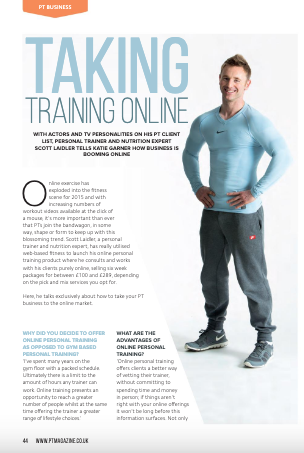
It’s difficult to say exactly who the first online personal trainer was, especially if we’re going to define the service by working one on one with clients and delivering a custom training plan. For example, I started my online fitness coaching service back in 2015, by providing custom workout programs delivered on a Word document, the service was novel enough to warrant press attention in both trade and consumer magazines.
But even then there were notable service providers already working at a significant scale, for example, The body coach & Kayla Itsines were both selling widely popular guides and have since gone on to evolve with new technology and amass millions of social media followers. One may even argue that in the truest sense, the first form of remote online personal training was back in 1951, when Jack Lalanne began hosting The Jack LaLanne Show, where he guided television viewers through exercise programs.
Variations on Online Personal Training
The fitness industry is highly entrepreneurial, and becoming an online personal trainer usually isn’t something that you apply to be, as a job, at least it wasn’t in the early days.
Ironically, unlike most professions, online personal trainers existed before online personal training qualifications did, as the opportunity to reach a wider audience, qualified personal trainers like myself began offering online versions of existing one-to-one services, in 2023 newly qualified personal trainers can enter the industry, and take an online personal training qualification with providers such as with the training room to help them work with online clients, or indeed begin their career as online personal trainers, without a focus on working with clients in person at all.
Again, because online fitness coaching is still in its infancy compared to where we’re heading, there isn’t a standardised service offering to expect, in fact, there really isn’t even a standardised way to describe the service either. So here are some other phrases that might be used to describe online personal training.
- Online fitness coaching
- Online strength coaching
- Online fitness instruction
- E-fitness coach
- Remote personal trainer
- Digital fitness coaching
- Virtual personal training (though some people make the distinction here that ‘ virtual personal training’ refers to live video call workouts)
Cultural differences contribute to the range of descriptors, for example in the U.K. where I live, fitness professionals tend to refer to themselves as personal trainers, whereas many of my Middle-Eastern clients will call me ‘coach’, Interestingly, one might argue that in the U.K and in the USA and Australasia the term ‘coach’ is generally a sporting term, slightly outside the sphere of fitness training. Further still, what those in the USA might describe as Fitness or strength & conditioning, those in continental Europe often call sports.
Other Online Fitness Options
For the purposes of simplicity let’s arrive at defining online personal training as the literal digital equivalent of the one-on-one personal trainer/client dynamic. This generally means a personal trainer-designed training program and in-depth support with a single, dedicated trainer.
Online personal training vs In-person Personal Training
I Believe online personal training has become such a huge part of the modern fitness industry for two reasons, firstly The world has changed, we live far more digital lives, many of us work from home, and for many years now the internet has been a safe, reliable and reputation led place to make transactions, not to mention the advances in technology and fitness apps like Trainerize and PTdistinction that have freed online personal trainers from painstakingly slow work with spreadsheets and PDFs and equipped them with advanced app infrastructure allowing seamless workout delivery, amendments, instant messaging and integration with many wearable devices and caloric trackers such as Myfitnesspal.
The second reason for the rise in online personal training is that working virtually has provided an answer to in-person training’s biggest blindspot. Which is that whilst in-person workouts are great, all too often personal trainers focus very little on what happens in the rest of their client’s week.
Of course, this isn’t going to be true for all personal trainers, but In my observation, the exception proves the rule, typically in-person trainers think of their service offering as the one-hour training sessions they deliver, which is why you are charged an hourly rate. Inexperienced personal trainers seldom factor in the considerable time it takes to plan and monitor a client’s progress, so unfortunately this work just doesn’t get done, which means they might provide excellent workout sessions but not provide much oversight in between meetings and most communication is just logistical and focused on setting up the next training session.
The big contrast then, is that online personal training typically works more like a retainer on a month-to-month basis or for a pre-determined period of time, e.g. 12 weeks throughout which the coach will offer support on every aspect of their client’s journey.
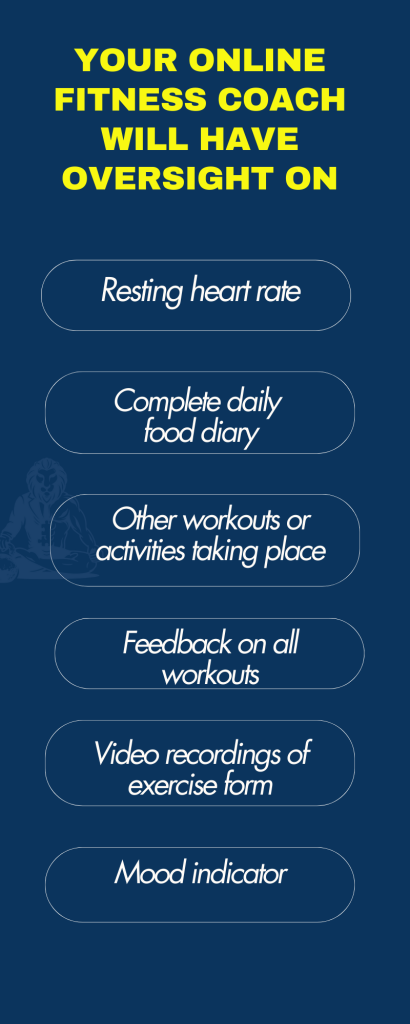
This means that, unlike an in-person trainer, and thanks to technology, your online fitness coach will have oversight on lifestyle elements. For example, these are just some of the things I have oversight over with my clients:
- Resting heart rate
- Complete daily food diary
- Any other workouts or activities taking place in addition to the workouts set in the program
- Feedback on all workouts
- Video recordings of exercise form
- Mood indicators
Not only that, but many online personal trainers now offer some form of direct instant messaging with their clients, which means that support is far more rapid and forthcoming.
Again, as an experienced personal trainer, I’m sure I could offer you a great workout in person, and we could arrange to do that multiple times per week. However, like all good coaches, I also know that ultimately whether you as my client would achieve your goal or not would be determined just as much by the actions you take outside of the gym as any amount of workouts I could possibly deliver in person, therefore being able to offer support for healthy eating, managing stress and prioritising rest whilst helping you stay motivated and accountable are all features of online personal training that can be found wanting in traditional in-person training scenarios.
Let’s sum up some of the competitive advantages one has over the other:
Pros of One On One Personal Training
Overcoming Gym Anxiety: It’s quite common to suffer from gym-related anxiety, especially in the early stages of your fitness journey, it’s never easy to enter an environment you know you’re a total beginner in, knowing there will be hundreds of advanced people in the same space.
Sometimes, just having a plan to follow can aid in reducing anxiety simply because it removes the guesswork and offers structure. However, if you really experience strong anxiety about stepping into a gym when being accompanied around the gym floor by a supportive personal trainer is going to be incredibly helpful.
Direct Accountability: It doesn’t get more accountable than knowing someone is literally going to be waiting in the gym for you if you don’t turn up, and that’s one of the major galvanising forces of having an in-person trainer, in fact when I worked in Los Angeles, I actually used to drive to each of my clients and pick them up, before driving to a local gym or park to train, imagine not showing up to that session and having me sat outside your house all morning.
Of course, online personal trainers have various mechanisms in place to provide massive accountability, but it is going to be difficult to beat the kind of social guilt associated with leaving your trainer high and dry, and in the name of a little tough love, the industry-standard cancellation policy fee serves to ups the stakes.
Exercise Technique: In-person fitness trainers will be able to show you exactly how to perform exercises with great technique, if you need to, you’ll be able to spend whole sessions dedicated to the coaching points on difficult exercises, which might be of particular utility for exercises like bent over rows and deadlifts that are a bugbear for many.
Of course, online personal trainers have an answer to this, with both exercise demonstration videos with teaching notes and, as with my service the ability to send videos of yourself doing an exercise for feedback.
Pros Of Online Personal Training
Convenience: You can’t get much more convenient than having the answers to all of your fitness questions via a direct line to your fitness coach, all delivered right to an app on your phone.
Of course, you could WhatsApp your in-person PT, but they won’t (or shouldn’t) be able to answer when they are with their clients (which will be most of the day) and may consider frequent fitness questions somewhat out of scope for the service they deliver, certainly once they’ve hung up their spot watches after a full day on the gym floor, only the most dedicated will go home and answer what can easily amount to hundreds of messages every day.
Whereas online fitness coaching is swift and comprehensive to daily messages, well which is the very backbone of the service, so if you require continuous support or would appreciate some back and forth on the methodology in a workout program, making this a big win for online personal training.
Workout on Your Schedule: When you’re working with an in-person personal trainer, you will need to sync up diaries to get your training sessions booked, which means that the more sought after they are, the more limited slots get, even when they aren’t a heavily sought after coach, you’ll still need to sync up, which gets trickier and more complex the busier you are.
With an online personal trainer, your coach will have sat down with your requirements and built a program for you, then once you have your program you will be free to carry out the workouts at a time of your choosing, this flexibility could be the difference between getting a workout completed or not.
Choice of Trainer & Specialist Expertise: With online personal training being completely remote, you can essentially choose from what are now thousands of online fitness coaches and match your choice of trainer to the kind of skillset and experience you need. You can also match for personality and select someone you actually want to work with because you like them.
It’s one thing if you live in a big city like London or New York, as there will be hundreds of personal trainers in travellable distance, but if you live in a small town or rural area, what are the chances that your local PT also just happens to be the best trainer in the world for you, quite slim I would think.
Online personal training solves that problem entirely. It also means that you can seek out specific trainers for specific goals, let’s say you want to run your first triathlon and you want to do it online, rather than see if your local strength & conditioning coach who loves bodybuilding could rustle a plan together for you, why not work with Mikael and his team over at https://scientifictriathlon.com/ who specifically specialise in preparing people to run triathlons. Likewise, if you wanted to specifically work on your powerlifting technique and prowess you could seek out the services of Chad Wesley Smith over at Juggernaut https://www.jtsstrength.com/online-coaching/powerlifting/
Choice of location (or multiple): gyms aren’t for everyone, in fact, many people find them intimidating enough to be prohibitive, so the ease and comfort of being able to train at home is a huge plus for online personal training.
Of course, you can have a personal trainer come to your home, but that’s space and schedule-dependent. Location-wise, where online personal training comes into its own is that a workout program can be implemented over several different locations, which is extremely useful for those who travel frequently. It’s not uncommon for my custom online training clients, I build two or even three programs that run in parallel to accommodate frequent location changes.
360 Holistic Approach: Again, not all but most in-person trainers will focus predominantly on the workouts they deliver during their training sessions. The advantage of the kind of technology online fitness coaches have at their fingertips means that they are in a position to offer suggested meal plans and healthy lifestyle measures then track them and provide accountability to the same degree as workouts.
For instance, I often offer my online personal training clients the opportunity to track habits such as a daily mobility flow, an evening meditation, and a daily water intake target, amongst other more individual habits that might like to track for overall benefits to mindset, personal development, and productivity.
This means that when working with a well-being-focused online fitness coach, alongside achieving your obvious fitness goals, you may stand to improve your relationship with food and invest in your mental well-being too.
Unparalleled Support: In the early days of online personal training, coaches like myself had to prove the concept that personal training could indeed be effective online, one of the ways this was accomplished was to over-deliver on the weak point of in-person training, which as I mentioned above tends to be supported outside of primary workouts. This means that now the top online personal trainers will have any combination of coaching calls, check-ins, instant messaging support, reminder prompts, and support systems in place which means if it’s accountability, motivation, and support you are looking for, an online product might be just what you are looking for.
Progress Tracking: One of the big advantages of online personal training is that there is scope to track a wide range of progress markers from weight, to side-by-side pictures all the way to resting heart rate and the ability to track wide-ranging health habits. Again, these are all possible to track in person, but unfortunately rarely are in practice.
Price: As with any service, there is always going to be a spectrum of prices. The major advantage of online personal training is that you can often work with your chosen trainer for a month or even a 12-week program for a fraction of the cost in-person sessions would cost with a less experienced coach. You may wonder how much online personal training costs. While there is no definitive answer to this, you should expect to pay anywhere from £50-£300 per month depending on the level of support on offer.
Online vs. In-Person Training: My Verdict
As I’ve mentioned, over the years I’ve had the privilege of engaging in both in-person and online personal training. Both methods hold their unique benefits and appeal. In-person training offers the immediacy of feedback, the tactile correction of form, and an intrinsic connection between client and trainer.
However, as our lives become increasingly digital and interconnected, the scope and potential of online personal training services have grown immensely, leading me to firmly believe in its superior advantages. One of the most profound benefits of online personal training is the comprehensive oversight it provides on all aspects of a client’s fitness journey.
Online fitness training transcends the limitations of scheduled gym sessions, allowing for a holistic approach to wellness. It incorporates not just the training sessions but a 360-degree view of your health, including diet, rest, mental well-being, and lifestyle habits. This overarching perspective enables us to identify and address challenges or opportunities that may be missed in the confines of a gym. It’s important to acknowledge that fitness is not achieved in an hour of exercise; it’s a continuous commitment that integrates into every aspect of your daily life. And this is where online personal training decidedly comes out on top.
Online Alternatives To Personal Training:
I’m trying to keep this guide as concise as possible, but it’s fair to say that there are a number of hybrid services and combinations of efforts, For example, many of my clients still go to the occasional group fitness class, others keep their racquet club memberships or keep training with their rowing clubs, others pay an in-person trainer to deliver the program I’ve built them online, so there is plenty of flex in service offerings.
To expand on that, there are many other services that are indeed online fitness services but aren’t in the truest definition, an online personal training service.
Fitness Guides & Online Training Programs: PDF fitness guides are really how selling online fitness products started, there are still hundreds of comprehensive fitness guides and training programs that can be followed on a self-led basis, in fact you can follow some of my signature fitness programs in this manner. These can be a cost-effective way to get a good training program, of course as these are in a written format, they won’t be personalised and you won’t have accountability support throughout the process, but the program may still be very effective if implemented correctly.
Online Fitness Programs with Customer Support: In this setup, a pre-set program already exists to achieve a certain goal or to serve a certain audience. You sign up for the program either independently or sometimes as part of a cohort and work your way through the program. Coaching or customer service support may be available throughout the program, more often than not you will be assigned various coaches or support staff over time, though they will be able to pull up your account for continuity. Think of this kind of coaching as 100% reactive, akin to a customer support ticketing system.
The advantages here would be that courses can be offered to serve a particular purpose alongside a proven training program offered at a lower rate than more personalised coaching. Typically a program purchased on this basis will not be personalised, so if you have any specific requirements these may not be able to give you exactly what you’re looking for.
Fitness Apps (library content): There are hundreds if not thousands of fitness apps available on the Google and Apple stores for immediate download, and many more web-based services. Service offerings and niches vary in levels of support. This form of online fitness offering generally serves as a library of pre-recorded workouts that can be pulled up at any time, generally speaking, guidance and planning on these apps will be self-led or suggested to you based on algorithmic data that approximates the best guess as to what you might like or benefit from, so you lose the coaching touchpoints here, but these apps are operating at scale meaning their monthly price point could be as low as £2 per month.
Social Media Follow-Along Workouts: There are a number of social media workouts to follow along all over YouTube and Instagram, almost all of which are free to use and follow along, again, these workouts are often very effective stand-alone workouts, especially when it comes to to the yoga/ pilates end of the fitness spectrum, for example, I like the work of Boho Beautiful Yoga & Jessica Valant Pilates However, the nature of stand-alone follow along workouts can lack a coherent narrative and whilst often offer great stand-alone workouts, may lack the cohesion of a full training program.
Intensity in a workout isn’t the sole indicator of its effectiveness. Just because a session leaves you sweaty and sore the next day doesn’t mean it’s helping you reach your unique goals. The key to an impactful fitness program lies in the synergy of its components. Think of an expert personal trainer as a master watchmaker: it’s not just about individual gears and springs, but how they work together in perfect harmony that makes the timepiece—and your fitness program—exceptional.
Live Streamed Workouts: Peloton has made a huge splash in the live workout genre in recent years, and there are various other service offerings that offer live-streamed workouts at various experience levels to achieve various goals. This offers the accountability of showing up to a scheduled event, alongside the convenience of doing workouts in the comfort of your own living room. Of course, the downside is that the sessions will be delivered to many people at the same time, which means personalisation won’t be possible.
Virtual personal training: This is a challenging one to define because what has come to be known as ‘virtual’ personal training, is working one-on-one with a personal trainer through video conferencing. Whether or not your trainer is also programming your health & fitness regime and offering accountability over a period of time, or simply offering a ‘virtual’ version of the one-hour training session model will vary from coach to coach.
The online fitness market is constantly evolving and it isn’t uncommon for a particular coach or brand to offer a variety of the services above as well as comprehensive online personal training.
Workout Program Design: There are services where you can hire a personal trainer or indeed an online personal trainer to create a training program for you, which is delivered purely as a training program and intended to be self-led. So in this instance, the guesswork question would be answered, but not necessarily the accountability. This type of setup works well for athletes and those who are seeking performance increases but don’t really additional accountability.Â
Is online personal training effective?
Most experienced online personal trainers, myself included will be able to demonstrate a track record of success with their clients providing case studies, testimonials, and impressive before and after transformations. For example, you can view both my clients’ results and my online personal training reviews elsewhere on this website.
However, if you are new to the idea of fitness being delivered online then it might prove reassuring to see some independent research carried out into its efficacy. There have been numerous studies conducted on the effectiveness of online personal training as a concept, and the results have been overwhelmingly positive.
Part 2: How Online Personal Training Works
Now that we’ve identified what online personal training is, let’s really get into the details as to how the process works.
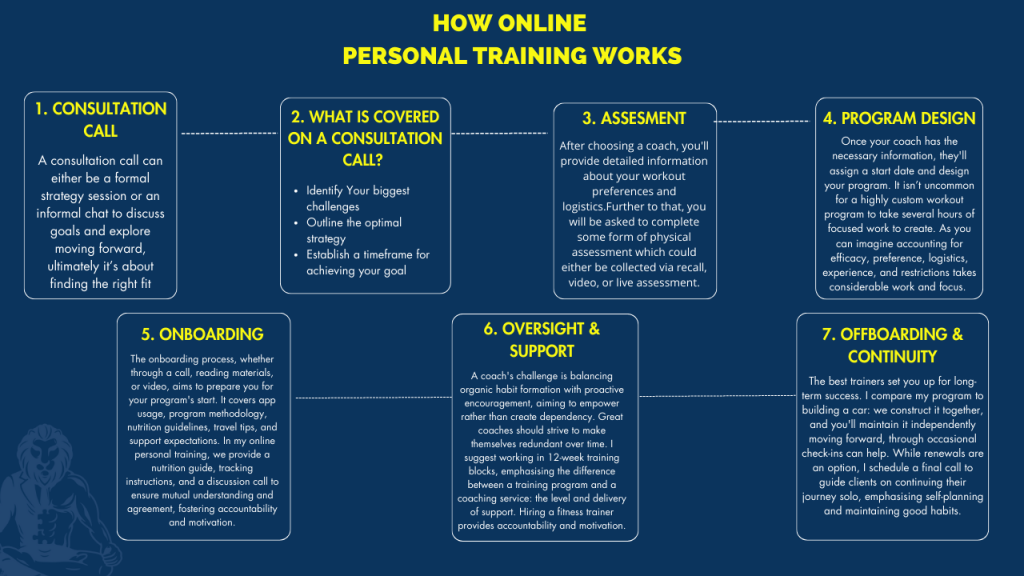
First, let’s have a look at the process of online personal training, I’m going to take you broadly through the process I use with my online clients, of course, I haven’t peered behind the curtain of too many of my contemporaries, but the process of all of the top online trainers will generally have some form or other of each of the steps I outline.
The Process:
Consultation
A consultation is not always necessary if you’ve been doing some research on your coach for a little while and are pretty set on moving forward, you may have seen enough from their social media or website to have decided you’re in the right place, and you can purchase a package from their website without any prior contact.
in my experience, I would say that it is about 50/50 in terms of those who buy right off of my website and those who prefer to book a consultation prior to moving forward. A consultation call can either be a formal strategy session or an informal chat and what moving forward together might look like, ultimately determining the right fit.
What is covered on a Consultation call?
I like to cover three things on consultation calls with potential clients:
- Identify Your biggest challenges: If we are able to name and identify what seems to be holding you back, we can start forming a plan to overcome it. This helps identify trends, potential misconceptions, and any repetitive mistakes that may have been made on previous attempts at the same goal.
- Outline the optimal strategy: Of course, putting together a comprehensive training program from scratch takes time, but that doesn’t mean that a rough outline of strategy can’t be approximated on a call, experienced coaches will be able to form an excellent strategy for you very quickly.
- Establish a timeframe for achieving your goal – Once we know what the goal is and identify any constraints around it, we can discuss a reasonable time frame for its completion. This helps align expectations and allows you to get a feel for how soon you should expect results.
Ultimately the purpose of the consultation is to confirm a good fit for both parties. If you have a level of rapport, agree on the strategy, and are confident that you can execute the proposed plan, you have all the makings of a winning partnership.
I believe this initial conversation is important because sometimes misconceptions or unhealthy habits around health & fitness are so ingrained that there is not going to be a route to success unless old patterns are changed, It’s better to have this kind of conversation before deciding to move forward.
For example, potentially inbound clients have asked me to condone a low caloric intake they had been given by an influencer or picked up in the depths of a weight loss forum and the level of restriction was so low that I would consider it unethical to move forward on that basis, as I was sure it was not only unhealthy but could never lead to maintainable results. Therefore not only could I not condone it, but I couldn’t turn a blind eye either, as I knew it wouldn’t end well for them, and being willing to look the other day, is essentially tacit approval.
This is why making sure training philosophies are aligned from the offset is so important, otherwise, you are either going to bump heads with your coach or be working with someone who would knowingly allow you to continue to make mistakes that undermine your progress, which offsets the point of being led by a coach you’ve put your faith in.
Assessment
Once you’ve decided to move forward with your chosen coach there will be a process of collecting as much information as possible that could possibly inform your program. This information will cover everything from the logistical aspect of where your workouts are going to take place, all the way through to your preferences on things like exercise diversity and intensity. I have documented my process of accounting for the 28 factors that influence a workout program in a guide that pulls the curtain back on how custom personal training programs are built – You can read the guide here.
Further to that, you will be asked to complete some form of physical assessment which could either be collected via recall, video, or live assessment. This can help inform your trainer on things like posture, body composition, freedom of movement, and coordination. All of this allows the trainer to further calibrate the program to deliver the best possible experience for you.
Program Design
Once your coach has all the information they need to design your program or assign you one of their signature solutions they will generally assign you a start date. This is really where the magic takes place from a coaching perspective. There are multiple routes to the same goal, determining the path with the most likely success for an individual is the experience you are paying for in a personal trainer, which is why I would always suggest caution before moving forward with ‘do as I do’ coaching and influencing.
To peek behind the curtain a little, it isn’t uncommon for a highly custom workout program to take several hours of focused work to create. As you can imagine accounting for efficacy, preference, logistics, experience, and restrictions takes considerable work and focus.
Having the right program can be the difference between achieving your goals and not, it’s also true that not everyone needs a totally custom program, sometimes a well-trodden path that’s served many before you with the right support is more than enough to get you across the finish line.
Onboarding
The onboarding process may take the form of a welcome call, written materials to read, or a pre-recorded or personalised video message. Regardless of the delivery method, ultimately the intention is to ensure that you are fully equipped to hit the ground running at the start of your program.
This covers everything from how to use any app you are using, to the methodology in the program, how best to approach nutrition considering your goal, what to do when you travel, and indeed what kind of support to expect and how to ask for help.
For example, in my custom online personal training tier, alongside a comprehensive nutrition guide to accompany a suggested meal plan, and written instructions on the kind of things we will be tracking throughout the course of coaching we also schedule a call to discuss the program in its entirety and satisfy any questions or concerns.
This onboarding call also serves the secondary, though equally important purpose of allowing my client and I to verbally agree that the program that has been designed for them has been understood and can be implemented by mutual agreement, of course, an informal agreement, it does wonders to galvanise mutual accountability and motivation.
Oversight & Support
One of the greatest challenges a coach faces is knowing when to allow habit formation to form organically and when to proactively jump in and encourage, ultimately coaching can either be an empowering experience or it can create a dependency on external support.
It’s a fine line to walk. Personally, I believe the intention of a great coach should be to render themselves redundant on a long enough timeline, having fully equipped their client with the tools to move forward alone. This is why I tend to work in 12-week initial blocks of training, we’ll get to what happens at the 12-week mark in a moment.
The difference between buying a training program and investing in a coaching service is the level of support you get and the manner in which it’s delivered to you. After all, part of the reason you would want the help of a fitness trainer is to offer a sense of accountability and bolster your motivation.
Online personal training support is generally offered in four ways:
Proactive Oversight: Oversight is different to support, modern training apps allow coaches to see a wealth of daily data telling them exactly how their clients are getting on. Knowing that your coach will catch downward trends even before you’re aware of them is extremely reassuring and plays a big part in accountability.
This type of oversight allows a coach to intercede when a problem presents itself, but take a backseat when all is well to allow independent habit forming to take place.
Scheduled Communication: The next type of support on offer comes in the form of scheduled touch points, usually referred to as ‘check-ins’ or ‘catch-ups’ These could come in the form of internal reports, personalised videos, whats app exchanges, or mostly commonly coaching calls. The frequency of these will vary depending on your choice of trainer and coaching package.
One thing to consider here is that if there is a lot to catch up on weekly or monthly, in many ways that belie a lack of oversight, personally I would rather there not be a lot to ‘catch up’ on because any potential challenges were addressed and nipped in the bud as soon as they arrived, for this reason, my coaching service allows for strategic problem-solving calls to take place where necessary but ‘catch-ups’ in my view are redundant.
Reactive Support: This refers to an open channel of 2-way communication where any questions or concerns can be bounced from client to coach, not every online fitness coach offers unrestricted messaging support, certainly not with the same coach throughout your experience, which is not necessarily a program, though it can be harder to invest emotionally in multiple coaches rather a single consistent coach throughout your course of coaching.
In my experience the major utility of reactive coaching support is that it massively shortens the time that efforts can be wayward and unchecked, Consider for a moment if all you had was a monthly check-in, but you made a mistake in implementation or lost momentum right after your last call, this could mean a month of unsupported sub-par performance, with the combination of proactive oversight and unrestricted instant messaging problems can be nipped in the bud very quickly. Consider how off course a ship could get if it was just one degree off its planned route but allowed to run uncorrected across the open ocean, one degree in port would end up as hundreds of miles over time.
Adaptations: Changes may need to be made to your training program as you go along, whether it’s because of travel, personal choices, or an unexpected setback. This is a normal part of the process. Even though we start with a well-thought-out plan based on experience, real life can sometimes throw us curveballs. The ability to quickly adjust to these changes is a big advantage of dynamic online personal training, setting it apart from fixed programs.
Off-boarding & Continuity: One of the things you should determine when selecting your chosen online personal trainer is understanding what happens at the end of your time working together. The top online personal trainers ensure your training can continue smoothly even when the program ends. I like to think of my coaching program as building a car. Together, we’ll assemble it, and in the end, you get to keep the car. I’ll explain how it works and what to watch for. Over time, you’ll need to change parts – like swapping meals and workouts – but the car will keep running if you look after it. You might want to bring it in for a tune-up or upgrade occasionally, but you won’t need a constant co-driver. Essentially, my goal is to equip you with a lifestyle plan that you can manage independently in the long run.
Of course, there are generally also going to be options to renew should a longer time frame be appropriate for your goal, or you simply want to extend the benefits of accountability and oversight beyond your initial training package.
My personal process is to schedule a departing call at the end of an initial course of coaching to ensure that my clients are equipped to take their training efforts forward alone, discussing how to plan their own workouts and maintain positive habits.
How Online Personal Trainers Measure Progress
Measuring Progressions
There’s an age-old saying in coaching circles: “What gets measured, gets improved.” This principle suggests that the simple act of tracking an aspect of your performance or behavior can inherently lead to improvements. By regularly measuring, you bring attention, focus, and awareness to that area, which can stimulate positive changes, often subconsciously. This is the power of measurement – it not only provides a baseline for where you stand but also propels you toward where you aspire to be.
Fitness tracking apps and their ability to sync with wearable devices offer coaches a great deal of data with which to gauge progressions, these can include qualitative and quantitative measures, I find that having a mix of the two help suit most personalities and offers more of a 360 overview of how things are going.
Let’s explore some of the variables that are often tracked by online personal trainers:
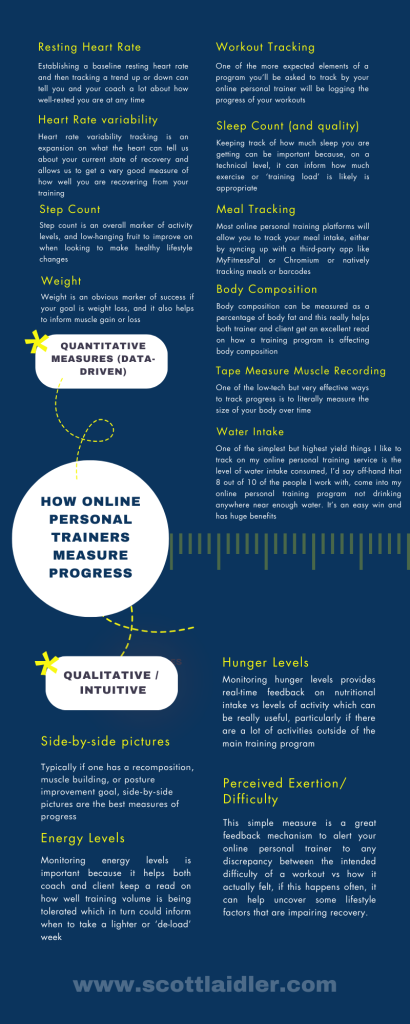
Quantitative Measures (Data-driven)
Quantitative data serves as a powerful tool in our journey towards improved fitness. By tracking specific, numerical information like body weight, body fat percentage, or how much weight we can lift, we can paint a detailed picture of our current state and how it changes over time. This numerical data offers a clear, straightforward path to measure our progress.
As we see these numbers change – the scale tipping less, the weights getting heavier – we can easily visualise our progress along a linear route. This tangibility is immensely satisfying and often a strong motivational factor, making quantitative data an invaluable part of any fitness regimen.
Resting Heart Rate: Establishing a baseline resting heart rate and then tracking a trend up and down can tell you and your coach a lot about how well-rested you are at any time. Generally speaking, the fitter you get the lower your resting heart rate will be. There is personal variance to this, with some people naturally having a lower heart rate than others, also in well-trained individuals, it’s quite common to be below the normal range, but obviously get that checked if you are concerned. As you get more in tune with your body, you will start to observe periods of fatigue bringing with them a higher resting heart rate.
Heart Rate variability: Heart rate variability tracking is an expansion on what the heart can tell us about your current state of allows us to get a very good measure of how well you are recovering from your training by measuring the distance between heartbeats, just like with resting heart rate, once you establish a baseline you’ll be able to tell with a very quick and simple daily measure whether your scheduled workout would be best deferred or regressed in the name of thorough recovery.
Workout Tracking: One of the more expected elements of a program you’ll be asked to track by your online personal trainer will be logging the progress of your workouts, this allows you to track the trajectory of your performances to make sure they are unfolding as expected and as programmed. It’s important to stress that if you’ve paid for a workout program to be built for you by a trainer you believe in, you should perform the workout exactly as planned, because changing parts of the workout may have unintended consequences, I’ve outlined many of them in an article titled: How to tell if a workout program is effective.
Step Count: One of the measures that is easily tracked by syncing phones and wearable devices is to keep track of a person’s daily step count. Step count is an overall marker of activity levels, and low-hanging fruit to improve on when looking to make healthy lifestyle changes
Sleep Count (and quality): Keeping track of how much sleep you are getting can be important because, on a technical level, it can inform how much exercise or ‘training load’ is likely is appropriate, because if you aren’t sleeping enough you may not be able to recover from a high volume of exercise. On a deeper level regularly not getting enough sleep may spark a conversation about your priorities. Technology like Apple Health and Oura rings are able to give you a sleep quality score as well as track the duration.
Meal Tracking: Most online personal training platforms will allow you to track your meal intake, either by syncing up with a third-party app like MyFitnessPal or Chromium or natively tracking meals or barcodes.
Technically if you have a meal plan built for you by a nutritionist or dietician as part of your online personal training package, you don’t actually need to track your meals as by definition if you implement your meal plan comprehensively you will be right on target as it was built for you. However, if you are tracking against a calorie and macronutrient target, our clients have found it particularly beneficial to have the oversight of a nutritionist providing oversight on a food diary looking for opportunities to optimise has been hugely beneficial.
Weight: Weight is an obvious marker of success if your goal is weight loss, and it also helps to inform muscle gain. If you are looking to lose body fat and gain muscle at the same time, it starts to lose its relevancy, this is because there is no utility in losing your lean muscle mass on the scale.
One huge tip I could give you is that weight is a relevant marker of success to the extent that you have a lot of weight to lose, as you start to come in closer to your ideal weight, to see continued success you’ll need to focus more on body composition so a weight loss goal, if successful for long enough becomes a fat loss goal, whereas unsuccessful weight loss goals remain weight loss goals, due to their start, stop, lose, gain cycle.
Body Composition: Body composition can be measured as a percentage of body fat and this really helps both trainer and client get an excellent read on how a training program is affecting body composition, as this often tells a more informing story than purely tracking weight fluctuations. This is because there is no utility in losing muscle, in order to weigh less on a scale as it would impede your metabolism. Bio-impedance scales either at home or in a gym setting take body composition measurements in 30 seconds and although not always 100% accurate, do show a trend over time.
Tape Measure Muscle Recording: One of the low-tech but very effective ways to track progress is to literally measure the size of your body over time, whilst it takes a little admin and you may need to enlist the help of a friend or partner, it really helps demonstrate that getting in shape can be demonstrated elsewhere than the scales
Water Intake: One of the simplest but highest yield things I like to track on my own online personal training service is the level of water intake consumed, I’d say offhand that 8 out of 10 of the people I work with, come into my online personal training program not drinking anywhere near enough water. It’s an easy win and has huge benefits.
However, it is worth stating that the amount of tracking should fit your personality. What I mean to say is that it is possible to over-track. Whilst some individuals are seriously data-driven, others prefer a more intuitive approach to fitness. For example, if I suggest we track a short meditation practice each day, and you miss it because you decided to watch a movie or see friends, ultimately something that might be equally relaxing, but you experience guilt, shame or hold the missed habit as a frame of reference for failure, then what was intended as something positive and informal could become negative. This is the sort of nuance that can be discussed during a comprehensive onboarding process.
Qualitative / Intuitive
When we talk about measuring success in personal training, it’s important to understand that it’s not just about the numbers. While quantitative measures, such as weight loss, body fat percentage, or lifting records, are crucial, they are only part of the story. This is where qualitative or intuitive measures come into their own.
Qualitative measures are about the non-numeric, yet highly significant aspects of your fitness journey. They tap into the subtleties of your experience and provide a more holistic picture of your progress. Instead of focusing solely on hard data, qualitative measures look at factors such as improvements in energy levels, sleep quality, mood, self-confidence, or even your relationship with food and exercise.
These measures are intuitive, meaning they require you to listen to your body and be in tune with how you’re feeling physically and emotionally. While these elements might not be as easily quantifiable, they are just as vital, if not more so, to your overall wellness and journey into personal development than any single goal in your fitness journey.
Side-by-side pictures – Typically if one has a recomposition, muscle building, or posture improvement goal, side-by-side pictures are the best measures of progress. After all Aesthetic differences, are often heavily linked to increases in confidence, a major driver for starting a health & fitness program in the first place.
Energy Levels: Monitoring energy levels is important because it helps both coach and client keep a read on how well training volume is being tolerated which in turn could inform when to take a lighter or ‘de-load’ week. Not only that, monitoring energy levels allows us to keep an eye on how other areas of life might sap energy and affect training progress. For example, if work or family pressures begin to encroach on recovery, sometimes an exercise regime needs to be adapted to weather the challenging period, a workout program is only ever as effective as your ability to recover from it.
As a quick aside, over 70% of my inbound online personal training clients report that they are entering the program with barely enough energy to get through the day. For this reason, I treat increasing baseline energy levels as an equal goal to the more obvious ones such as weight loss, muscle gain, etc.
I say it’s equally important because when you have abundant energy levels, you’ll eat better, and be less likely to skip workouts, which in turn will help you sleep better, creating a positive cycle that makes everything you achieve on a fitness program easier to maintain once it’s finished.
Hunger Levels: Monitoring hunger levels provides real-time feedback on nutritional intake vs levels of activity which can be really useful, particularly if there are a lot of activities outside of the main training program, for example, imagine someone plays tennis three times each week, a tennis game could be wrapped up in half an hour in straight sets or be a 3-hour epic, these are the sort of variables that can’t necessarily benefit from forward planning, but can easily be reacted to and corrected.
Perceived Exertion/ Difficulty: This is an industry-standard intuitive measure of how hard a workout felt, also known as the Borg rating. Like everything there is nuance to this too, for example, a short session, may feel harder than a big slow weights session, but the weights session might take a lot more out of your central nervous system. Nevertheless, scoring the difficulty of a workout from 1-10. This simple measure is a great feedback mechanism to alert your online personal trainer to any discrepancy between the intended difficulty of a workout vs. how it actually felt, if this happens often, it can help uncover some lifestyle factors that are impairing recovery.
Do Online Personal Trainers Help With Nutrition?
When embarking on a fitness journey, your nutritional strategy is a crucial pillar of success. It’s often said that “you can’t out-exercise a bad diet,” and this holds true whether you’re aiming for weight loss, muscle gain, increased endurance, or overall health improvement. The fact is, your nutrition and exercise regimen should work hand in hand to propel you toward your goals.
Scope of Nutritional Advice: Varying Standards & Regulations
The scope of nutritional advice that personal trainers can provide varies depending on regional regulations, qualifications, and accreditations. In some regions, personal trainers can offer full meal plans, while in others, they’re limited to providing general advice on caloric intake and macronutrient targets.
The gray area lies with recipe suggestions and meal planning. If a personal trainer provides you with several recipe ideas that you follow for breakfast, lunch, and dinner, this could technically be seen as a meal plan. However, the line is often blurred, with no clear consensus on when recipe suggestions transition into meal planning.
Nutritionists and Dieticians: A Distinctive Role
One important distinction to remember is that personal trainers should not use nutritional advice to diagnose or treat medical conditions. This falls within the realm of dietetics, which is a different profession requiring different qualifications.
For example, in my online personal training service, I’ve always partnered with professional nutritionists for meal plan creation, despite having my own nutrition qualifications. This collaboration allows me to focus on the training aspect while still providing my clients with robust nutritional support.
But even then, I still don’t hold any of my meal plans out as a medical service, that is outside of the scope of online personal training. Think of a meal plan delivered by a trainer more as a demonstration of how meals could feasibly combine to arrive at the numbers that make your training goals possible, not as prescriptive advice.
What to Look Out For
Regardless of how your chosen online personal trainer deals with nutrition – whether by providing guidelines, macronutrient profiles, their own meal plans, or partnering with nutrition specialists – it’s essential to assess the depth of the knowledge on offer.
Following a set of numerical guidelines can be helpful, but it can also lead to an overemphasis on quantity over quality. This is a common criticism of the “If It Fits Your Macros” approach. While it’s theoretically possible to manipulate weight and body composition through macronutrient numbers, optimal health goes far beyond the simple equation of calories in vs calories out.
You might be surprised at how unhealthy some food choices can be, even when they “fit the numbers.” That’s why it’s important to go beyond a purely aesthetic focus and prioritise a nutrition strategy that promotes long-term health.
A Holistic Approach
In my online personal training service, we approach nutrition with a three-pronged strategy: providing balanced meal plans, considering the macronutrient profile, and ensuring that all advice aligns with our client’s long-term health interests. This approach is overseen by our resident integrative health expert, Dr. Olivia Lesslar. Her expertise ensures that our nutritional advice doesn’t just lead to physical changes; it’s also scientifically sound and contributes to overall well-being.
In conclusion, the right nutrition advice from your online personal trainer should be considered, holistic, and focused not just on achieving short-term goals, but also on promoting long-term health.
Summary of the Benefits of Online Personal Training
You have direct accountability: Perhaps the greatest benefit of having an online personal trainer is that when you find the right fit with the right coach, you’ll have someone just as invested in your goals as you are. Checking in to make sure you’re ok if you miss your scheduled activities, you’ll also have someone cheerleading you, celebrating your wins, and providing excellent support at the click of a button.
Remote Coaching Is Flexibility: The flexible nature of working with your chosen online fitness trainer means that you aren’t stuck trying to sync up schedules, you simply carry out your workouts according to your own plan, the tops trainers will also adapt your training program during periods of travel or large workloads to help keep you moving forward.
It Will Completely Remove Guesswork: If you’ve suffered from inertia as a result of too much conflicting health & fitness information, second-guessed the way you’ve put your own workouts together or simply felt an intuitive sense that what you’re doing just isn’t working for you, Online personal training can solve all of that for you overnight.
Once you’ve had your training program delivered for you, as long as you have faith in your coach all you need to do is follow the program that’s been created for you personally and you’ll get the results you’ve been looking for.
You’ll have someone to help with motivation: Having an online personal trainer in your corner can be very motivating, particularly because they will be accessible at the click of a button, so if you face a challenge or just need a bit of a jump start they will be on hand to provide just that, keeping you motivated and focused.
It removes friction and enables you to start: Online personal training removes a lot of friction that could be in your way right now, first of all, if you want, you can train in the comfort of your own living room, you can start without a gym or any equipment, and any questions you have about your program can be answered right there on your phone or desktop computer.
Addressing Common Concerns About Online Personal Training
Online personal training is a rapidly growing industry that offers a range of benefits, from convenience and flexibility to personalised workout plans. However, as with any service, it may raise some concerns for potential clients.
Here are some of the potential concerns that people might have about online personal training:
Lack of Community: Some people may feel that online personal training lacks a sense of community. This really depends on the provider, for example, my service is a very one one-on-one service, so if the community aspect were a huge motivator I might suggest seeking other providers. Many providers offer live online classes or have community forums where members can discuss their progress and encourage one another.
Having said that, in full transparency, online fitness services are going to have a hard time replicating the kind of community you would get by joining a local CrossFit box or the atmosphere you might get in a soul cycle class for example, so if the energy of a group setting has been a big part of your fitness journey, that is something to consider before taking your training online.
Lack of Face-to-Face Interaction: While it’s true that the physical presence of an experienced trainer can be incredibly beneficial, the comprehensive oversight and accountability you receive from a top-notch online personal trainer can often exceed it. In-person training sessions, albeit effective, usually concentrate all support, feedback, and communication into the one-hour session you share with your trainer. This approach can sometimes leave the remaining 167 hours of your week relatively unsupported.
In contrast, online personal training is designed to provide a continual, strategic support system that extends beyond the confines of scheduled workout sessions. Your online coach, though not physically present, will be monitoring your progress, adjusting your program, and offering guidance day in and day out, creating a level of oversight that is usually not possible in the traditional gym environment.
This continuous monitoring allows for a more dynamic and responsive training plan, as your coach can make adjustments based on the data you provide, whether that’s tracking your nutrition, your sleep patterns, or your mood.
Furthermore, the touchpoints with online trainers are typically highly strategic and efficient. Because they’re not bound by the hour-long session, online trainers have the flexibility to communicate and offer feedback in a manner that is most effective for your progress, which can lead to a more integrated and personalised training experience.
Ultimately, while face-to-face interaction is a valued part of the traditional training paradigm, the robust support and accountability structure of online personal training often outweigh this aspect, making it a compelling alternative.
Technical Barriers: If you aren’t very tech-savvy, it can feel like a barrier to entry for online personal training. However modern training apps are so intuitive to use that beginners can quickly get to grips with the technology at hand, and if not any problems should be swiftly resolved by your trainer or a member of their team.
Connectivity can feel like a barrier, especially when you are in a remote area, but consider that you actually only need to sync up your app when you are within reach of a great signal, at other times you can implement the program on your own without having to be connected, for example, my clientele has included offshore fishermen, ranch owners in the rugged west of The USA, Military personnel stationed overseas, Those that drive heavy machinery in Australias’s outback, Pilots, Off-shore oil rig workers, GameKeepers on Nature reserves in Africa, and dozens of fly in, fly out (FIFO) workers from all over the globe, one of my clients was even writing a book in a Buddhist monastery when we worked together, location really is no barrier.
Customisation: At first glance, one might wonder how tailored an online training plan can truly be. Without the ability for in-person assessment, it’s understandable that potential clients might worry whether an online personal trainer can fully grasp their fitness levels, personal limitations, or specific goals.
However, it’s crucial to note that a well-structured online personal training service often involves a comprehensive onboarding process. This process typically includes detailed questionnaires, virtual consultations, and even video assessments that dive deep into understanding a client’s current fitness state, lifestyle factors, past exercise experience, and future aspirations. This in-depth initial analysis often surpasses what most in-person trainers would usually gather in an initial consultation.
Moreover, with continuous remote monitoring, online trainers can fine-tune programs based on real-time feedback and data, accommodating lifestyle changes, shifting goals, and personal growth throughout the training journey. As such, the level of customisation in online personal training can often exceed that of traditional in-person training.
Privacy: Privacy is a paramount concern in any service that requires sharing personal information, and online personal training is no different. However, potential clients should be reassured that professional online personal training platforms take privacy very seriously.
Reputable online personal trainers and services will have clear and comprehensive privacy policies, along with terms and conditions that protect your data and your rights as a consumer. These policies ensure that your personal information, including health and fitness data, is stored securely and used responsibly. They also typically provide options for clients to opt in or out of specific types of data sharing or communication.
Furthermore, a hallmark of a high-quality personal trainer, whether online or in-person, is emotional intelligence. This means they are attuned not just to your physical needs and goals, but also your comfort, boundaries, and personal preferences. A trainer at the top of their game will prioritise your comfort and never pressure you to share more than you’re willing, or disregard your privacy requests.
Part 3: Finding The Right Online Personal Trainer
How do you know if a Personal Trainer is good?
Personal trainers in my experience should be considered coaches because exercise planning and nutrition advice are all great, but more often than not the success or failure of a health & fitness program is ultimately going to come down to having the discipline, consistency, and motivation to see it through to its completion. After all the best workout program in the world is going to be no use if you don’t do it, That’s why personal trainers can’t just be workout designers, they need to be coaches too.
There are different coaching styles and personalities, and just like anything else in life some will resonate with you more than others, for example, some would be completely put off by a drill sergeant-type persona, and others would be in lockstep with it, so to speak.
On the other hand, many would benefit from a more encouraging, understanding dynamic whilst some could consider it soft, and too friendly to really hold them accountable. Highlighting the need for a good personal fit.
One of the skills of being a great coach is being adaptable, which calls upon emotional intelligence. Of course, coaches all have their unique natural personalities, but the ability to mold their communication style to an individual client in a way that doesn’t go so far as to be inauthentic is a skill that can take years to develop.
This is necessary because everyone has a unique personality with unique goals, hopes, fears, and associations with exercise, food, and even authority that if you can’t adapt to can leave a coach coming across as rigid and dogmatic.
I view the coaching process as something akin to an art form. There is a pre-requisite knowledge base, there are best practices, there is the ability to recall information, there is the ability to create training programs, there is the ability to show others what has worked for you, and then, there is coaching which is the ability to get reliable get results for a diverse range of people with unique circumstances.
How to Find a Good Personal Trainer:
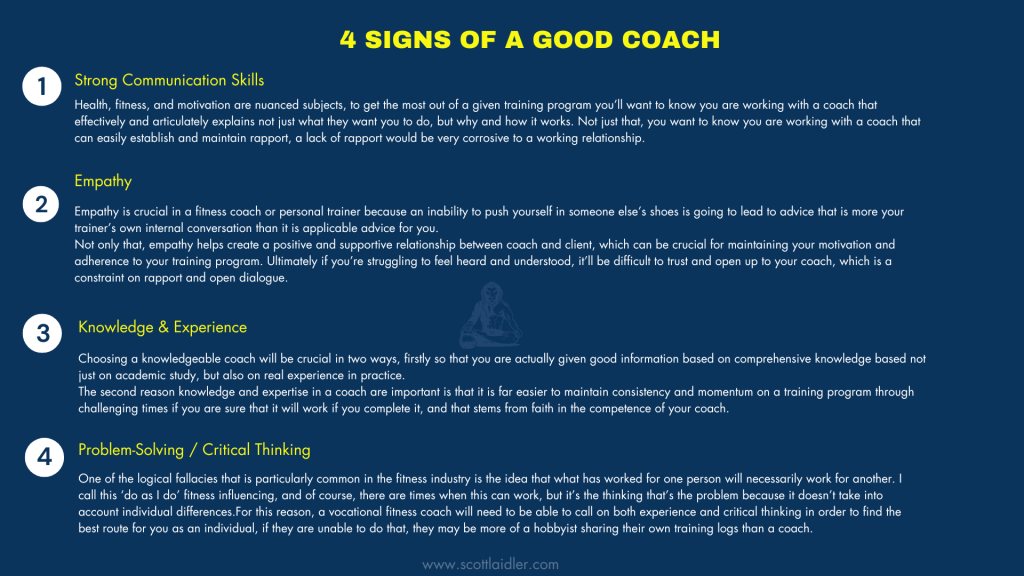
Strong Communication Skills: Health, fitness, and motivation are nuanced subjects, to get the most out of a given training program you’ll want to know you are working with a coach that effectively and articulately explains not just what they want you to do, but why and how it works. Not just that, you want to know you are working with a coach that can easily establish and maintain rapport, a lack of rapport would be very corrosive to a working relationship.
Empathy: Empathy is crucial in a fitness coach or personal trainer because an inability to push yourself in someone else’s shoes is going to lead to advice that is more your trainer’s own internal conversation than it is applicable advice for you.
Not only that, empathy helps create a positive and supportive relationship between coach and client, which can be crucial for maintaining your motivation and adherence to your training program. Ultimately if you’re struggling to feel heard and understood, it’ll be difficult to trust and open up to your coach, which is a constraint on rapport and open dialogue.
Knowledge & Experience: Choosing a knowledgeable coach will be crucial in two ways, firstly so that you are actually given good information based on comprehensive knowledge based not just on academic study, but also on real experience in practice.
The second reason knowledge and expertise in a coach are important is that it is far easier to maintain consistency and momentum on a training program through challenging times if you are sure that it will work if you complete it, and that stems from faith in the competence of your coach.
Problem-Solving / Critical Thinking: One of the logical fallacies that is particularly common in the fitness industry is the idea that what has worked for one person will necessarily work for another. I call this ‘do as I do’ fitness influencing, and of course, there are times when this can work, but it’s the thinking that’s the problem because it doesn’t take into account individual differences.
Just because a certain trainer or influencer has seen results with a popular training method or diet or is keen to share ‘what I eat in a day’, it doesn’t necessarily mean that it will work for you, so following this kind of programming blindly may not be your most linear route to success, and actually may lead to frustration or worse.
You’d be amazed how many of the people on my online personal training programs, have reached my service having previously been expected to live like a professional bodybuilder, despite having little time, a young family, and a general lack of energy.
For this reason, a vocational fitness coach will need to be able to call on both experience and critical thinking in order to find the best route for you as an individual, if they are unable to do that, they may be more of a hobbyist sharing their own training logs than a coach.
For fun, let’s labour the point, let’s say you wanted to gain muscle, well, you might think, who has the most muscle? Bodybuilders, right? Ok. Who was the best bodybuilder? Well, arguably Arnold Schwarzenegger. Great, so let’s do exactly what he did in his heyday, to gain muscle.
Ok perfect! So that means you would need to train twice per day, 6 days per week, and occasionally take long trips to a lake to do hundreds of squats with logs over a 4-6 hour period.
You’ll also need to sleep between your two workouts each day and eat upward of 5000 calories daily. For motivation, it would also help if all your friends were professional bodybuilders and you incessantly strategised about how to gain more muscle together for hours on end before practicing posing in a mirror for an hour to critique your statuesque physique. Sound reasonable?
Just because it would work technically, doesn’t mean it is in any way appropriate for you. Most people would be completely burnt out on the regime above, not to mention it being completely unfeasible logistically for busy professionals.
And that’s not a knock on Arnold by the way, truth be told I’d probably not even be writing this guide had he not sown the seeds for the fitness industry, but that doesn’t mean I’ll follow his regime to gain muscle.
So ensure that your program is made for you, your life, and your schedule rather than being inherited from a coach who has made fitness or bodybuilding their hobby, career, and sport, and expects the same of you. Whilst the workouts would technically work if you don’t have time to implement them, recover from them, or have the rigidity of schedule to implement what amounts to an athlete’s training routine, the program may be ill-fated from the beginning despite being technically sound, context matters.
Three Questions To Ask Yourself About Your Online Personal Trainer
What might be a great idea is to create a short list of 3-5 potential fitness coaches you might like to work with, for example, you could google ‘online personal training’ or ‘best online personal trainer for ‘x’, and have a look at the first page or two on google, keep tabs open for the 3-5 you intuitively feel look professional and then ask yourself the questions below:
Do I generally like, trust, and respect them?
You’ll be working closely with your online personal trainer so as with any interpersonal dynamic it’s important to make sure that you actually feel good about the person and actually want to be there.
Now, you could argue that liking isn’t as important as trust and respect, for example, I remember in the early days of my career I would teach boot camps in cold wet London parks at 6 am most mornings, I’d guess those in my groups didn’t always like me, certainly not mid burpee as was the style of training, but by 7 am they were always pleased they have attended.
That’s not really what I mean though when I refer to liking, it’s more of an intuitive feeling you get that your coach is in it for the right reasons, and conducts themselves in a way you both trust and respect, as I say there isn’t much more I can say about it, as it’s an intuitive feeling you’ll get about someone’s vibe.
What I will say, is that whilst first impressions are huge, I’d still recommend that you take a good amount of time to go through some social media, articles, and the website of some potential coaches to see if your initial impressions hold true as you get a feel for their personality, training philosophy, and track record, of course even better if you can get them on a consultation call to confirm your assumptions for yourself.
Consider again that trust and respect can be different from liking, it’s one thing to know you might want to be friends with someone, and another to have faith in their ability to coach and lead you to the successful completion of your goals.
Are they the right fitness coach for my goals?
Defining your goals can massively help you find the right personal trainer. For example, you might find a personal trainer with a tonne of great reviews and think to yourself that you are pretty confident that you like their vibe overall, but if they don’t have a track record or interest in helping people achieve similar goals to yours, it might not be the best fit.
To highlight the point, I lay out exactly why I’m a coach on my About page, Essentially my job as a coach is to help busy people become fit, gain more energy, and build a sustainable routine for health and fitness. What I aim for is to help my clients make the most out of their lives by being present and able to enjoy their favorite activities with their loved ones.
If you join my online personal training program with a goal like running an ultra-marathon or becoming a competitive bodybuilder, while I may have the skills and knowledge to understand what would be necessary to help you achieve these goals, I’d consider them too specialised for the majority of my clients, so you won’t see me talking about this kind of fitness. My focus is on creating fitness habits, workouts, and goals that align with your everyday lifestyle. So if you have a specific sports-related goal, you might be better off with a trainer who specialises in that area.
What’s My Budget?
Budget plays a big factor in which personal trainer or service offering you choose, so first things first make sure if you are paying personalised prices, that you are actually getting personalised service, otherwise you might as well just go with an effective self-led program for a fraction of the price.
With that said, as mentioned above you can expect to spend anywhere between £50 and £300 each month for online personal training. However, if you don’t have to, I would urge you not to make your decision based on price, but rather on value. If your health & fitness goal means a lot to you, you’d probably be willing to trade the cost of services for the result, wouldn’t you?
Let’s put it this way if you had a leak in your ceiling right now, would you want the cheapest plumber or the plumber you were most certain would give you a permanent solution to the problem? Not only that, but if you chose a cheap plumber who couldn’t solve the problem, or even made it worse you would then have to go out and find another plumber who actually could do the job, so you would have ended up paying far more than you would have originally if you had just gone with the best in the first place, plus you would still have to deal with all the damage caused by the leak in the meantime. Through the health and fitness lens, this means the distance between where you are now and the completion of your goals continues to grow, causing a lot of wasted time, effort, and frustration.
Another analogy might be, where you had to prepare your car for a cross-country drive, would you want the cheapest service carried out on your car or the most comprehensive?
You would likely make your decision based not on price but on the consequences of breaking down halfway, or worse never making it to your destination, of course, there is greater risk in highway driving than there is in taking on a poor workout program, but when you consider for example that some people are one more failed attempt at weight loss before giving up for good, the analogy starts to carry over.
From a psychological perspective, there is actually evidence to suggest that when we invest in high-value, comprehensive products and services, we value them more, take them more seriously, and actually care about wasting or under-utilising them. This is a known psychological principle, called the endowment effect, in fact, a study in the International Journal of Evidence-Based Coaching and Mentoring in 2018, found that clients who invest more in coaching and consulting services tended to go on to have a more positive outcome and were more likely to see the intended results.
Translate that over to health and fitness and it means that if you make a considerable investment in a coaching product you are more likely to see it through to its completion with consistent effort, not a bad thing when you consider this is exactly how to get results in health & fitness works.
Of course, this doesn’t mean that you should just go for the highest-price coaching service you can find, I’m just making the point that decisions made solely on price could end up being a false economy in the long run.
Some Potential Warning Signs To Avoid:
Just as there are some things to look for in a great fitness trainer, there are also some common red flags that you’ll want to avoid:
Unwilling to adapt: When someone finds a system of training, eating, and thinking that works for them, that’s fantastic and you can understand why they would want to tell people all about it, often when they do, they pick up a big following and sell their ready-made solution in good faith. However, health & fitness can be a very individual pursuit, so one-size-fits-all all solutions just won’t work for everyone.
There is a big difference between having a product, program, or course and having real-world experience in coaching. All manner of things can present as challenges along the course of a program if you’re coach is unwilling or unable to find a solution to a problem and always defaults back to the initial set plan, this isn’t going to bode well for your long-term success, life is rarely plain sailing.
Makes you feel bad: Human relationships work on small but consistent exchanges of energy and emotion, if you often feel yourself feeling bad after interacting with your coach that isn’t a good sign. Coaching is nuanced and as coaches it’s our job to walk a fine line between delivering some home truths and actually being offensive, Emotional intelligence bridges that gap so look out for a lack of it when you’re researching your online personal trainer.
Ultimately, in personal training as in any field, there will always be a minority of people on a bit of a power trip, who use their position of authority to control, demean, and chastise. Due diligence and listening to your intuition are key to helping avoid this.
Too focused on themselves: If you start to get the feeling that your coach spends most of their time influencing, you may start to wonder how much coaching they actually do, It’s a good question, sometimes coaches are prolific workers, and other times they are more interested in social media kudos than getting clients across the finish line. You’ll generally get a feel for this when speaking with a potential trainer, or indeed when it transpires that you are unable to.
Wants you to be restrictive: Probably more linked to ‘do as I do’ coaching, than actual malicious intent, if your trainer is suggesting that you take an overly restrictive approach to your caloric intake, then the approach isn’t going to be maintainable, which means you won’t achieve results that can be sustained.
My advice would be to avoid working with anyone who believes a consistently low caloric intake would be a good idea, In fact, I remember being told during a consultation once, that a young woman who wanted to both lose weight and get fit was too scared to exercise because she knew that with the unsustainably low caloric intake, she had been advised on that if she were to exercise the resulting hunger would be unbearable. You can imagine how long that kind of approach can be maintained and how much damage it can do physically and mentally.
Isn’t qualified: To be clear here, a qualification in personal training is not a guarantee of effective coaching, that’s a skillset honed over time and requires a high degree of emotional intelligence, not just retained knowledge. On the other hand, the absence of a qualification is not proof that an individual doesn’t know the subject matter, or how to get results. For example, I’m sure a big wave surfer could teach us all a lot about strength, balance, mindset, and consistency, without necessarily being a qualified PT.
What it does indicate though is a lack of intent to make a professional career of personal training for the long term. The reassuring aspect of working with a certified trainer is that you can rest assured your coach has been educated in professional conduct and standards and has the pre-requisite qualification for being insured to deliver coaching in the first place.
Whilst we shouldn’t confuse qualifications with ability, it should be the first and most important check box ticked when considering hiring an online personal trainer, it’s just good practice.
Is Always Selling: I don’t necessarily think there’s anything wrong with recommending excellent products you’ve tried for yourself to your clients if you believe they will contribute to great results but if you get the feeling that your coach is promoting all sorts of supplements and gimmicks before they’ve really delivered any value, as if they were trying to make a commission on a cruise ship, that’s probably a red flag.
Is Still Finding Their Feet
In today’s social media era, it’s easy to be drawn to influencers and coaches who are openly battling the same issues as you. Remember, though, you’re not seeking a friend or looking to do someone a favor when you hire a fitness coach. You’re seeking a solution to your challenges, not a reflection of them. It’s wise to invest in coaches who have successfully overcome the exact challenges you’re facing or have a demonstratable track record of doing so with other people.
We all embark on our unique journey to overcome challenges, a hero’s journey if you will. Keep in mind that you’re the hero of your story and what you need is a Mentor, not another hero to learn with. Make sure to hire based on this understanding.Â
Of course, I’m not nieve enough to believe that any of us are the finished article, but keep in mind that you’re seeking expertise and guidance, so look for experience and a proven-track record wherever you can, the wisdom that comes with years in the field might have you a lot of wasted efforts.
What You Can Expect From A Personal Trainer
When engaging with a personal trainer or coach, it’s essential to understand what to expect from them. This relationship should be defined and guided by mutual understanding and respect, often formalised in a service agreement or client-coach contract at the onset of the partnership.
Transparency is a cornerstone of the relationship with your trainer. You should expect honesty and integrity in all your dealings with them. A good trainer will have an open-door policy for discussions about any necessary adjustments to your strategy, aiding you in overcoming the inevitable challenges you’ll face on your fitness journey.
A trainer’s role extends beyond merely devising workout plans. They should consistently provide encouragement, fostering an environment that supports your growth and propels you towards your goals. Your coach becomes your champion, holding you accountable in a firm yet supportive manner. They will celebrate your victories and help you learn from any missteps, all the while ensuring that their support doesn’t turn into coddling.
One key aspect of a personal trainer’s role is to ensure that you don’t unknowingly make mistakes that could derail your progress or cause injury. This is where oversight comes in they will monitor your form, diet, and overall approach to ensure they align with best practices and your specific goals.
Finally, an effective personal trainer’s ultimate objective should be empowerment. They strive to equip you with the necessary knowledge, tools, and confidence to take control of your health and fitness independently. Your coach’s end game should be to create a self-sufficient you, capable of maintaining your health and fitness year-round.
This self-reliance signifies that you’ve not only achieved your fitness goals but have also acquired the tools to sustain your progress long after your formal relationship with your coach concludes.
9 Point checklist before hiring an online personal trainer:
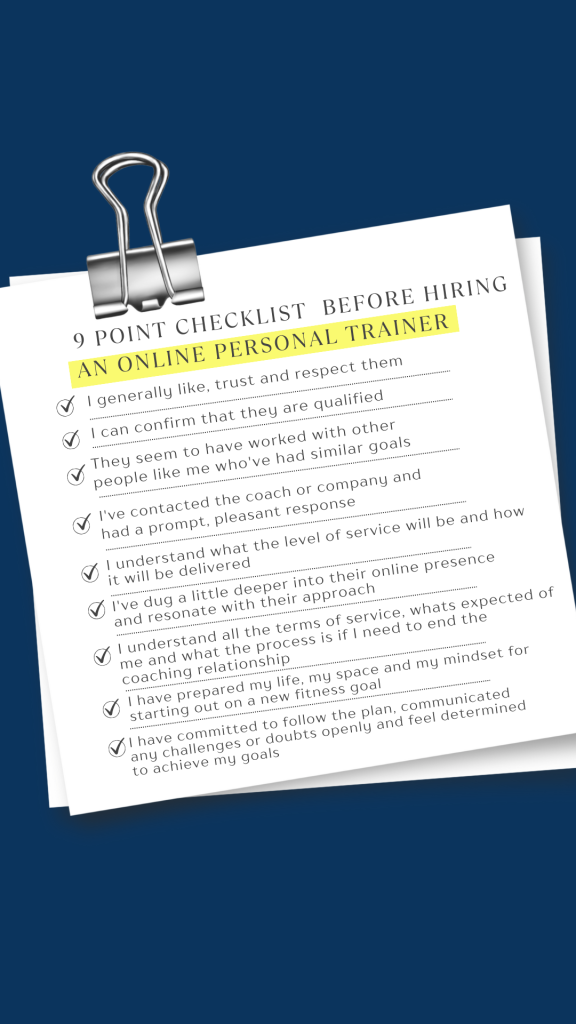
Part 4: How To Get The Most Out Of Your Online Personal Training Experience
Just like any meaningful relationship, the one you form with your online personal trainer is two-sided. Achieving your fitness goals isn’t simply about hiring a coach; it requires your commitment and effort as well. Having a personal trainer isn’t a shortcut to results; rather, it’s about having a well-crafted game plan, constant support, and someone to hold you accountable throughout your fitness journey.
Be Clear On Your Goals
Getting very clear on exactly what you want to achieve and why is very important. I’m stressing the point about clarity because how you convey your goals is going to inform how your program is built.
For example, there is a big difference between saying you want to get stronger and saying you want to gain muscle. Although there is certainly a significant crossover and beginners might start in the same place, the more conditioned the further off of your intended trajectory you would become as the methods designed to gain muscle and those that get you stronger begin to diverge.
To play with the idea, let’s say you’re speaking about walking locations to a hiking enthusiast, they might be able to talk to you for hours about the difference between fields, meadows, woodland, bushland, hinterland, forests, and coastlines they might also tell you that there are ten major ‘types’ of hiking: from section hiking to bushwhacking whereas someone not particularly into hiking might just consider everything encompassed above as walking, outside. Don’t worry Experienced trainers will be able to read between the lines, but it’s still worth getting as clear as you can.
Understand and Communicate Your Why
Conveying why you want to achieve your goals openly is also important for two reasons:
firstly it helps get laser-focused on your goals. The truth about human nature is that we often have desires and emotions leading our actions, but we feel that we need to communicate these strong motivators, the problem is some clarity can be lost when these goals are conveyed in a more neutral manner, where clarity is lost so is direction.
To highlight what I mean, let’s say you have a holiday coming up, and your real goal is to feel confident on a beach, so you sign up for a trainer and say that you want to lose weight.
Let’s unpack what would lead to achieving the real goal vs. the described goal, as they are not necessarily the same thing. For example, to feel confident on a beach might mean looking athletic and lean in a swimsuit. To achieve this, you would want to be on a training program that would allow you to preserve your muscle mass and lose body fat because the goal is essentially going to be measured on how you look.Â
Whereas in the communicated goal of ‘i want to lose weight’, you would be pursuing a loss of weight on the scale. So if you were encouraged to restrict calories aggressively, it’s perfectly reasonable for you to be losing both muscle and fat, if this was the case, the more weight you lost (which you would celebrate) would actually undermine the athletic aesthetic element of your real goal, which is to look great and feel confident. Rendering weight loss as a goal, an arbitrary marker of success, after all, when was the last time someone asked you how much you weighed at the beach? If you want real results in fitness, nuance are clarity are important.
The second reason it’s important to be clear on what you want to achieve a particular goal is that in moments of doubt, or dipping motivation there is a good chance that your coach will be able to remind you of exactly why you want to achieve a certain goal which can really help you get right back on track. Think of it as the day-to-day equivalent of the moment a boxer is downed in a movie and needs to remind themselves of what they are fighting for. I’m not saying it’s going to be a movie moment but a coach who understands your true motivators can be an indispensable ally in your lowest moments. Very often I work with clients that see a dip in motivation, it’s common and happens to us all, however once reminded of their original desire to be a great role model for their children, or break a hereditary chain of diabetes sufferers for example, the drive to stay consistent soon kicks back in.Â
Be Coachable
Working with a coach is a little different philosophically from working with a doctor for example, where you might be looking for a diagnosis that was falsifiable, i.e either true or false, A or B, and you might also want to get a second opinion at any time to make sure that any drastic action is warranted.
Whereas working with an online personal trainer is much more like working with a sports coach, in that there are rules to the game and clearly desired outcomes, but many different approaches and potential routes to achieve the same goal so making sure that you’re going to be receptive to your coaches way of working is important before starting out, which essentially amounts to doing your due diligence.
Being coachable also requires transparency about your experience and track record with implementation. This can be jarring, and humbling even, especially if you have very specific knowledge and experience, that doesn’t necessarily translate over to your new goals.
For example, I’ve worked with high-level triathletes, who come to me to help them gain muscle and have never stepped foot in a weight room, in which case, they are actually contextually complete beginners, despite being seasoned athletes. This reality can take a bit of an adjustment.
On the other hand, psychologically investing in the methods of a new coach can be cathartic, in that it allows you to cast aside your reliance on previous ineffective methods, tactics, and advice that hasn’t been delivered for you. It’s cliche, but if you want to see different results from what you’ve gotten in the past, you are going to have to do something different to make that happen, keep that in mind whenever you receive new or counterintuitive methods in your program.
From a coach’s perspective, I would strongly suggest that before you sign up for your new training program you really are ready to cast off any old habits and preferences that haven’t served you.
Imagine you have an outdated software program that’s riddled with bugs and inefficiencies, yet you keep asking your development team to patch it up because that’s what you’re familiar with. Bringing in a top-notch software architect to manage this same flawed system won’t magically transform it into a state-of-the-art application. In the same way, asking a personal trainer or nutritionist to build a restrictive meal plan for you on 1200 calories because that’s what you’ve always done or insisting on weighing yourself every day on a weight loss goal, despite being aware that daily fluctuations are normal or even casting aside the same old push, pull leg workout you’ve been using for a year because you are just so used to it won’t suddenly become effective because they are being delivered through a trainer, you have to be willing to embrace change.
Trust The Process
Once you’ve done your due diligence on a coach, you really do have to trust the process, take on the new information, make sure you understand it and then implement and give it time to deliver for you, This is unchartered territory but it’s where you want to be if you seek to break through to a new level of success.
Communicate Your Challenges
It’s important to communicate any challenges or doubts you are having about your progress to your fitness coach. Sometimes a solution to a problem would be very easy to implement if communicated. For example, if your circumstances change and you are struggling for time to exercise, one way to deal with this would be to allow workouts to get less and less frequent, become frustrated and unmotivated, and eventually send your coach a message that you have to stop your program, some distance short of your intended goals.
However, a better way to deal with the exact same situation would be to tell your trainer that your schedule has changed but you’d like to see what could be done to make things work despite the time constraints. One simple conversation would then enable your coach to create a new version of your program that would allow you to achieve great results with the amount of time you actually have, massively different outcome and it was achieved by communicating a challenge as soon as it reared its head.
Be Honest With Tracking
If you feel that you would be judged or reprimanded for not following your plan, you’re with the wrong coach. Trust and empathy go both ways, if you can’t have a candid chat with your coach about why things aren’t going to plan for fear of chastisement then you should probably end the relationship as it’s not likely to lead to much growth.
Of course, encouragement is a fine line, you don’t want a coach to tell you it’s okay to just not follow the program either, this is why establishing the right fit is so important before ever signing up with an online personal trainer. Remember that your workouts are being created based on what is being suggested and tracked, for example, if you are undereating but reporting that you are hitting nutrition targets your workouts will be calibrated for a level of energy and recovery you won’t have and this may lead to burnout.
Don’t Change The Plan Without Asking Your Coach (Chesterton’s Fence)
Fitness is simple, but it’s also more nuanced than it seems at first glance. If you have a great coach your delivered program has been more thoroughly thought through than would even seem necessary on the surface. So it is always in your best interest to follow it as closely as was intended.
There are a couple of concepts that really help highlight what I mean which are Chesterton’s fence and second-order thinking/consequences., I’ll then highlight some examples of what I’ve seen go wrong in the past.
There is a concept that refers to the idea that one shouldn’t lightly change or remove a custom, tradition, or concept without first knowing why it was put there in the first place, This idea is attributed to G.K Chesterton, and is commonly referred to as ‘Chesterton’s fence’ the direct idea being that if you bought a piece of land and it had a fence on it, you shouldn’t remove it before you first understood what it’s original purpose was because you might subsequently discover why it was put there and no longer be able to avoid the negative consequences of its removal.
Whilst this might be solid practical advice if you have your eye on a smallholding, the real lesson here is in learning to practice second-order thinking.
Let’s Take A Look At Some Common Examples In Fitness
Let’s say you’ve been asked to walk daily, as LISS or steady state cardio to help burn fat. This type of cardio is at a deliberately light heart rate so it feels a little bit easy, you want to work harder so you turn it into a daily run and don’t mention it to your coach. You might be having a good run, but you’re now running an unintended heart rate, moving away from an intended fuel source, accumulating a greater level of fatigue, and burning more calories than was calculated for you, these are all second-order effects downstream of doing what seemed like was a good idea in turning an easy walk into a tough run. Your coach no longer has a read on your level of exertion, all future training plans you receive will be miscalibrated.
Here’s an example from a resistance workout. Let’s say your workout has been prescribed as three sets of 10 on a given exercise, you decide that this is a bit too easy, and you are keen to work as hard as you can, so you make it four sets of 20, and you’ll add a few more exercises for good measure, you are now training outside of the optimal rep range for gaining muscle at a level of exertion higher than your coach has calibrated for you, this can have second-order consequences of more fatigue, and fewer results. The good intention to work harder has undermined your results because your coach has calibrated the program perfectly for you in its original delivery.
Finally, let’s take an example from a meal plan, let’s say you have a weight loss goal and your suggested caloric intake is 1800 calories, you’re seeing good results, and you reason to yourself if I’m losing weight on 1800 calories, I’d lose even more weight on 1300, so you eat less hoping for faster weight loss.
Again, the second-order consequences will inevitably be tiredness, fatigue, poor workout performance, and slow recovery. If you go low enough you could even encounter metabolic resistance and stop losing weight altogether. You would then think to yourself that the program wasn’t delivering for you, but that is because you made the incorrect correlation that less was more, taking you out of the sweet spot that would have worked for you.
Second-order consequences matter, and it’s possible for seemingly innocuous alterations to undermine a whole training program because they compound over time. It’s always better to discuss making changes with your coach first, after all, that’s why you’ve hired them.
Review Support Material
Most of the top online personal trainers will offer supporting learning and explanatory material alongside their online workout programs. Often this material will have been curated from years of feedback gathered from previous clients that may share very similar goals to you, consuming this kind of material in full can add a lot of nuance and understanding as to the methodology underpinning any given training program, meaning that the material is intended to anticipate challenges and concerns. This way you start your program with a full understanding of the methodology involved, as we’ve noted above, the greater degree of faith you have in a training program, the easier it will be to stick to at your most challenging moments.
What Results Can You Expect From Online Personal Training?
The results from a course of online personal training can be as varied and individual as the clients themselves. However, with a commitment to the program and consistency in both workouts and nutrition, clients can expect to see significant improvements in their overall health and fitness. This might include weight loss, muscle gain, improved cardiovascular fitness, increased flexibility, enhanced athletic performance, or simply a better sense of well-being.
It’s important to remember that results don’t come overnight, but with time, perseverance, and the guidance of an experienced online personal trainer, clients can expect to reach their fitness goals and transform their bodies in a sustainable and healthy way.
You can hear some testimony from some of my online personal training clients discussing their journey in their own words here – Scott Laidler Client Testimonials
You can also find individual testimonies and more examples of exemplary results here. All credit goes to my clients for their hard work and dedication! – Scott Laidler Client Results
Final Thoughts To You Help Make Your Decision
I hope the above gives enough food for thought as to whether working with an online personal trainer might be a good fit for you. Here are some final thoughts on the subject.
Online personal training offers an extremely versatile approach to fitness coaching that puts you in control with ultimate flexibility, easily adapting to even the busiest lifestyle. Once you’ve been through my suggested process of determining the right online fitness coach for you, then the guesswork of health & fitness can be completely removed for you. As we’ve discussed the only significant drawback of online personal training is that the trainer will not be there with you in person for your workouts, so if that isn’t going to be a deal breaker for you, then going the online route with your training may offer the best of all worlds for achieving your health & fitness goals.
It’s worth reiterating that one of the keys to getting the most out of your online personal training experience is in doing the research it takes to find the trainers who is the best fit for you. Once you’re confident you’re in the right place and in good hands, you’ll be able to trust the outsourcing of your health & fitness decision-making, leaving you free to simply action a training plan you have faith in, this hugely simplifies what can be a very nebulous and confusing set of topics.
Online personal training may not necessarily be for those totally new to health & fitness regimes, not because it wouldn’t work because it certainly would, it just might be an overly elaborate solution to a simple problem.
This is because when you are entirely new to exercise almost any uptake in activity and healthy eating will deliver results for you as you’d have so much low-hanging fruit to utilise.
Of course, you may want to expedite your health and fitness journey by making sure it’s spot on from day one, but in full transparency, a less comprehensive preset online fitness program would be perfectly suitable if you are completely new to fitness. The important thing is that you start.
Where online personal training really shines is by delivering a truly personalised program built to meet you exactly where you are and then providing the accountability you need to see it through to its completion, so if you have a burning desire to change something about your health& fitness and are willing to invest in a custom solution, online personal training may be exactly what you’re looking for.
Part 5: Frequently Asked Questions
Are Online Personal trainers worth it?
The answer to this question largely depends on what you mean by “worth it”. Sure, the information to learn about fitness is available online, so theoretically, you could design your own program. But that’s akin to saying you could learn to fix your car instead of taking it to a mechanic. While possible, it’s not practical for most people who don’t have the time or inclination, and it would be tough to match a professional’s level of expertise. If you value having a straightforward plan for reaching your fitness goals, along with consistent support to achieve them, then investing in online personal training can be highly beneficial. To truly measure the value of online fitness coaching, don’t just think about the cost of the workout program. Consider how successfully reaching your fitness goals could transform your life. The right trainer can guide you on this journey and help make that happen for you, and that’s where the real value lies.
It’s also worth considering the opportunity cost of getting things wrong, having a plan going stale, not knowing when to switch things up, and unfortunately of working with the wrong personal trainers on a program that doesn’t deliver. The cost isn’t just the saving on doing things yourself, or the cost of a cheap training program it’s the wasted time and frustration you experience along the way.
Who are the best online personal trainers?
Determining who the best online personal trainer isn’t as straightforward as you might think. The “best” personal trainer can be a highly subjective concept, as it largely depends on individual needs, goals, and personality.
The ideal trainer for one person might not resonate with another. What matters most is finding the right online personal trainer for you. It’s about discovering the professional who perfectly blends their personality, philosophy, experience, and professionalism to align with your individual fitness journey.
The best trainer for you will be the one who understands and respects your unique goals, motivates you, and whose approach to fitness resonates with your own. You’ll want to find someone with whom you can build a strong rapport, as a solid client-trainer relationship is crucial for your success.
So, while I can’t make the definitive ruling on who the best online fitness coach is, and there are now thousands, I encourage you to consider the elements above when choosing who you” work with. However, If you want a shortlist of some of the top trainers out there to begin your search, the Institute of Personal Trainers has created a list,
How do online personal trainers modify workouts for clients with injuries or physical limitations?
Let’s make clear that diagnosing or treating medical issues isn’t a personal trainer’s role, that’s for medical professionals. But if you have the go-ahead from your healthcare provider to exercise, understanding your specific restrictions, a competent personal trainer can design a workout regimen that respects those limitations and helps you reach your fitness goals.
Not all trainers customise their programs, so search for those who do. Start a conversation with a few, and choose the one who seems most knowledgeable and enthusiastic about supporting you and your specific challenges.
Can I do online personal training from Home?
Definitely! Online personal training can be tailored to be entirely home-based, which is a perfect solution for those with work-from-home schedules, family responsibilities, or who simply prefer the comfort and privacy of their own homes over a traditional gym setting. Programs can be designed to utilise space efficiently and creatively, often requiring minimal equipment, making it easy to maintain a regular exercise routine without having to step foot in a gym.
Can I still work with an online personal trainer if I have a busy travel schedule?
Yes, certainly. Online personal training can be a perfect match for those with a busy schedule. When you have a custom workout program, your trainer can adjust it to suit different settings, making it adaptable to your lifestyle. For instance, I often create training routines that can be performed at home, in a hotel room, or in multiple gym environments to cater to my globe-trotting clients. This flexibility is where online fitness coaching truly shines over in-person training or preset programs which lack the capacity to adjust quickly to changing circumstances. It allows for a truly personalised experience, thats fitted around your life, not the other way around.
How do online personal trainers adapt workouts for different preferences (e.g. cardio, strength, functional fitness)?
Online personal trainers are typically proficient in designing a wide array of workout programs that incorporate diverse training styles based on your preferences. However, it’s important to understand that sometimes, your own strong preferences could be what’s hindering your progress.
For instance, if your goal is fat loss, but your training intensity is primarily burning glycogen, or if you’re focused on cardio but want to gain muscle, these preferences could be counterproductive. A competent trainer will discuss any such contradictions with you, working to strike the ideal balance between what’s most effective for your goals and what you’re going to enjoy. Part of the skill of coaching lies in creating plans that not only deliver results but also keep you motivated and invested in your fitness journey.
How do online personal trainers adapt workouts for different fitness backgrounds (e.g. beginner, intermediate, advanced)?
Online personal trainers are skilled in tailoring workout programs to cater to a range of fitness levels, be it beginner, intermediate, or advanced. Unless a coach specifically specialises in training individuals of a particular experience level, they’ll be willing to adjust their program to match your current fitness status and experience. This is typically determined during an initial onboarding call or information-gathering process at the beginning of the coaching program. Your trainer will assess your existing fitness level and use that information to create a program that is perfectly attuned to your individual needs and capabilities, ensuring a smooth and effective fitness journey.
How do online personal trainers adapt workouts for different time constraints?
Online personal trainers are well-versed in customising workout plans to accommodate varying time constraints. If you clearly communicate your available time or frequency limitations, your trainer will design a program that fits seamlessly into your schedule. An important aspect to note is that more time spent exercising doesn’t always equate to better results. Workout effectiveness tends to hit a point of diminishing returns after about 50 minutes. In fact, there are many instances where a well-designed 10-minute workout can yield remarkable results. So, regardless of how tight your schedule might be, a skilled online trainer can devise a fitness regimen that works efficiently within your time constraints. It’s inactivity you want to avoid, don’t let only having time for short sessions stop you from getting started.
How do online personal trainers adapt workouts for different ages?
Online personal trainers take into account the unique needs and considerations of different age groups when designing workout plans. While the core principles of fitness apply to all ages, certain age-specific factors such as recovery times, hormonal changes, and the desire to counter age-related health concerns like osteoporosis, are taken into account. For instance, older adults might benefit from more focus on balance and bone-strengthening exercises, while younger individuals may be able to handle more intense, higher-impact workouts. By considering these factors, an online personal trainer can customise a program that’s both safe and effective for any age.
Learn more about age-specific exercise considerations:
- My Guide to Exercise in your 20’s
- My Guide to Exercise in your 30’s
- My Guide to Exercise in your 40’s
- My Guide to Exercise in your 50’s
- My Guide to Senior Fitness
How do online personal trainers adapt workouts for different genders?
Online personal trainers create tailored programs that consider the specific needs and differences of each gender. While fundamental fitness principles apply to everyone, there are certain gender-specific considerations that come into play. These can include differences in muscular strength and endurance, hormonal fluctuations, and specific health concerns.
For example, women experiencing perimenopause or menopause, and men dealing with andropause (the male counterpart to menopause), may require unique training considerations. These can include adjustments to intensity, frequency, recovery periods, and even specific types of exercises.
Also, individual preferences and goals often vary between genders, which a competent online trainer will respect and incorporate into the program design. However, it’s essential to communicate any specific concerns or requirements to your trainer to ensure your program is perfectly suited to you.
How do online personal trainers adapt workouts for different goals (e.g. weight loss, muscle building)?
Each fitness objective, whether it’s weight loss, muscle building, or enhancing athletic performance, requires a unique approach. Online personal trainers leverage their education and experience to devise strategies that align with these diverse goals.
For weight loss, your trainer will likely design a program focusing on calorie-burning exercises and activities that elevate your heart rate, potentially combined with resistance training to maintain muscle mass.
On the other hand, for muscle building, the program would be more centered around resistance and strength training, ensuring progressive overload to stimulate muscle growth. Additionally, rest and recovery periods, diet, and supplementation advice might be part of the strategy.
However, it’s important to note that consistent effort is the key to achieving any fitness goal. The trainer provides the roadmap, but it’s up to you to turn the key and drive with dedication and persistence.
How do online personal trainers take into account dietary restrictions or allergies in meal planning?
Online personal trainers who offer meal planning services, either directly or through a partnering nutritionist or dietitian, should be fully equipped to account for dietary restrictions and allergies in the creation of your meal plan. When you begin your coaching relationship, you should provide all the necessary details regarding your dietary needs and preferences. This information will be incorporated to ensure that your meal plan aligns not only with your fitness goals but also with your overall health and well-being.
However, it’s crucial to match your needs with the right service. For instance, if you want to incorporate healthy fats from fish into your diet, but the trainer or service you’re considering specialises in vegan diets, it may not be the right fit. Always ensure that your chosen coach or service is capable of meeting your specific dietary requirements to guarantee the best possible results.
Part 6: Further Reading & Resources
- How to Achieve any Fitness Goal: The complete guide to Fitness Strategy
- How to think about fitness – A guide to cultivating a winning fitness mindset and developing lasting motivation
- A nutritionist’s guide to healthy eating – From macros to meal prep
- ExRx.net: This site is a comprehensive resource of exercise and fitness-related information, offering an extensive exercise library, calculators, and articles.
- My 28-Step Method for Building a custom workout program
- The Coaching Process: What to expect from online personal training
All Online Personal Training Guide Articles
- Understanding Statistics & Reading Studies
- How To Build A Workout Routine (28-Step Method For Personalisation )
- My Online Personal Training Coaching Process
- How To Stay Fit Over Christmas
- How To Give Fitness As A Gift (A Personal Trainer’s Guide)
- Why Waiting Until January To Start Your 2023 Fitness Goals Is A Mistake
- Is a personal trainer worth it?
- Do I need a personal trainer if I already go to the gym?
- Can a personal trainer help with your diet?
- How to find a good personal trainer or fitness coach